The Rules of Proximity
The stool is warm from the morning sun. He chose the corner, back to the wall, the angle that lets him see the door without seeming to watch it. Mark is at the counter with his back to the room, adjusting the grind. The sound comes in bursts, a whir and a stop, then the soft knock of the portafilter against the bin.
The coffee arrives black and shimmering. He wraps both hands around the cup. The humidity has already settled over the room, the hum of the air conditioning is audible above the sounds of the cafe. He likes the heat in his palms.
He thinks about the caregiver. The woman from Cebu, coming the following week. Amandha’s voice on the phone, clear and unhurried: Stop going through the agency. He was looking for the wrong thing. He had written it on the back of an envelope, stopped going through the agency, asked his network, and the network had done the rest.
Melbourne.
The memory comes as a bodily texture before it comes as anything else. The cool air of that autumn morning, the light still grey on the damp street. The door closing behind him. Leaving before she woke. The chih chik of the automatic lock. He has held that morning for a long time now, and what is left of it is a steady pull, the way a tide keeps pulling after the boat is tied up.
He has Elaine. Contact, presence, a full attention when they are together and an easy absence when they are not. Nothing is written down between them.
But Amandha is not Elaine.
The coffee cools. He does not drink it. Drinking would be beginning, and he wants to stay in the part before.
She is late.
Five minutes. Then ten. Other things exist for her, and then she arrives and all of her arrives with them.
His phone lies face down beside the saucer. He does not turn it over. He has been early for twenty minutes, because he wanted to be here.
The door opens and gives its small clack.
He knows her steps before he looks. Her weight comes down heel first and quick, as if the floor were a little behind her.
She goes to the counter first, not to his table. Her laugh arrives before her words do and Mark answers in a voice lighter than usual. David keeps his eyes on the window, where a bus is pulling out from the stop across the road, sunlight sliding off its flank.
Then she turns. Her eyes find him. Something in her face lets go of the alertness she carries in from the street and gives him something warmer and less arranged.
“Hey you. You’re looking like yourself this morning,” she says.
“I am myself.”
“Yes,” she says. “That’s what I mean.”
She sits. The stool takes her weight with a creak. Her bag goes on the floor and she hooks its strap over one foot. Black strap leather sandals, practical, scuffed at the toe.
“You got my advice,” she says. “The caregiver.”
“I stopped going through the agency.”
“And?”
“I asked my network. My customer service rep. She’s been with me since the first year of the cable business, back when it was cables. Her niece. Psychology degree, finished it, never practised. Went and did physical training for a gym instead.”
“And you hired her off that.”
“I hired her off this.” Mark brings her flat white over. She thanks him without taking her eyes off David. “There’s something in the way she pays attention. I can’t work out what it is. On the call she asked what my mother’s mornings look like. Not what’s wrong with her. What the mornings look like. She asked what she eats before she asked anything about the medication. And when my mother found the piano on the video call and started playing, she sang along. Like that was the interview.”
He looks down at the table, then back up.
“It feels right. I can’t tell you why. It just feels right.”
Amandha nods once, lifts her cup and drinks. “Does she speak Hokkien?”
“Some. Enough for my mother to feel at home.”
“That’s the part that matters.” She sets the cup down on its saucer with a small click. “Your mother will test her. They always do.”
He watches her say it. She is not reading this from a book. She has watched people fail at it, and watched others get it right.
“How did you know?” he asks. “On the phone. What I actually needed.”
“I didn’t know.” She glances at the window and back. “I saw what you were doing. You said the word Marina three times in five minutes.”
“Did I.”
“You did. The one who left.” Her voice does not soften. “You’re not over her leaving. You’re looking for her replacement.”
He doesn’t answer. Beside his hand the coffee has gone cold, a skin forming at the rim. He has not touched it since he sat down.
“I didn’t come here for the caregiver,” he says.
“I know.”
“I came because I wanted to be in the room with you.”
“I know.” Just looking at him.
She stands and picks up her bag. “I have something to show you. After this. If you have time.”
“Of course.”
He goes to the counter and orders himself a fresh one. Mark does not ask him anything. When David comes back she has her hand in her bag, and she draws out papers folded in thirds, the creases gone soft from being carried.
“These are the floor plans for my flat.”
He sits beside her, takes them, and unfolds them on the table between the cups. The paper is warm from her bag.
Late eighties, from the notation in the corner. Rooms arranged in the economical grid Singapore perfected, rectangles, every centimetre accounted for. At first they are only lines.
Then he reads them.
“Three rooms,” he says. “Almost equal. That’s unusual for this period. Usually the master takes most of the floor.”
He hovers a finger over the paper without touching it. “The kitchen wall. This one. It’s non-structural, see how the beam runs parallel to it. Take it down and you could fit a helper’s quarters. Small, but private. Put a separate entrance off the service door and it doesn’t touch the rest of the flat.”
She is watching him, not the plans.
“The caregiver will need her own space,” he says. “At my parents’ flat May already has a room. I’ll need another one.” He looks back down. “No pillars here, in the bathroom zone. You could widen the doors without losing anything. Wheelchair access. For whoever comes after. Or before.”
His finger moves to a corner. “Study here. North-facing. No direct sun in the afternoon. Good for screens, good for concentration.” A pause. “I need a room that is mine to work in. Home has nowhere to think.”
He keeps looking. Then he looks up.
“Do you have photographs?”
She already has her phone out. She scrolls with her thumb, unhurried, and turns the screen toward him.
Thirty-one of them. Thursday, the day she collected the keys. The empty rooms one after another, light lying flat on bare floor. The living room from the doorway. The window grille printed in its square of sun. The kitchen wall. The bathroom tiles. The first bedroom’s squared corners. The second bedroom, the blind not yet installed.
Then one she did not plan.
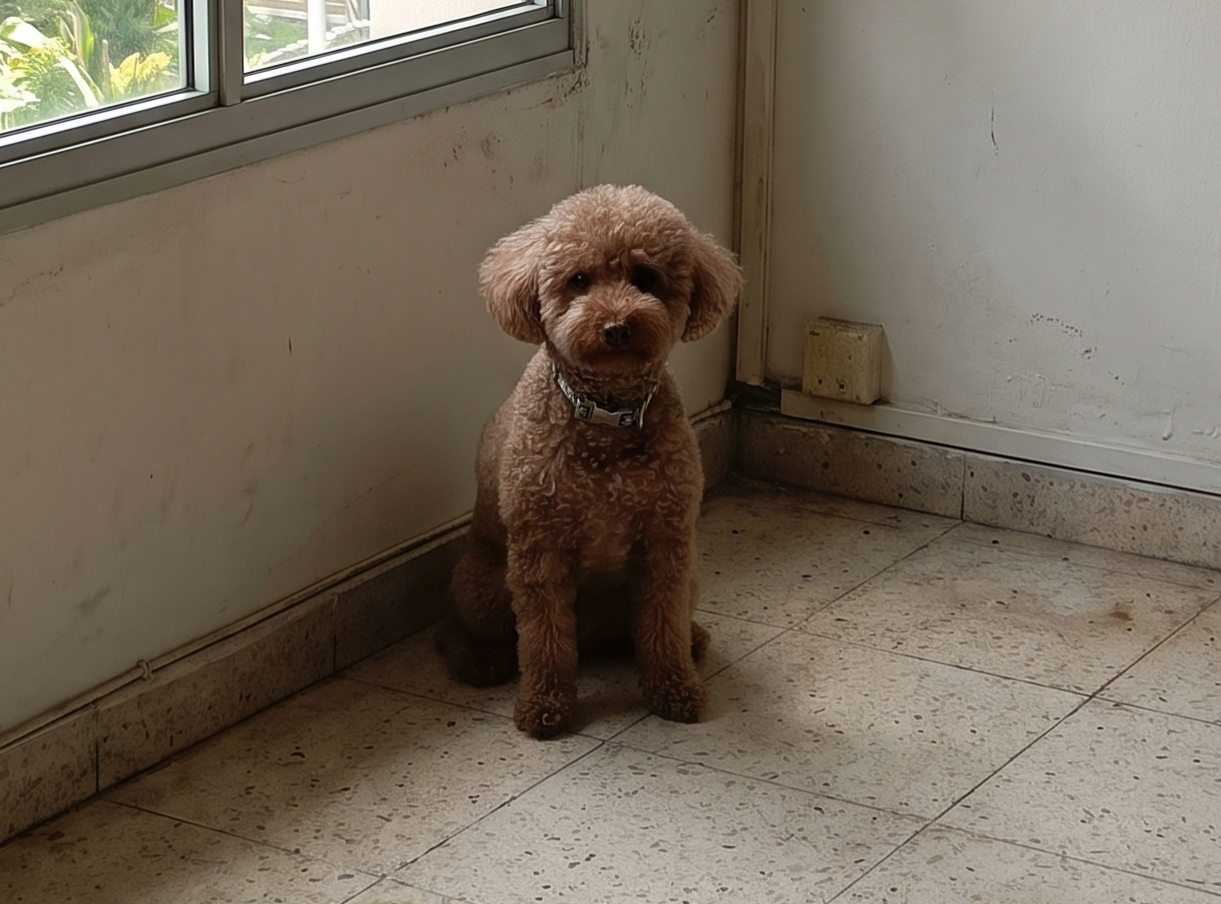
Yogi, the old dog, sits in the second bedroom, in the corner by the window where a bed would go. He is looking straight into the lens.
The glow of the screen sits on the sugar jar. Mark’s steam wand hisses and falls quiet.
“That’s Yogi. My dog. He doesn’t take directions,” Amandha says.
She slides the phone back into her bag.
“What are you asking?” he says. “To lease it.”
She doesn’t answer right away. Outside, the bus has gone, and the sun has moved across the table, over the folded plans.
“I don’t know yet,” she says. “Whether to move in. Whether to keep it empty. Whether to…” She stops. Looks at him. “Why?”
“I want it.” He looks at her. “Not for me alone. For Lina and Mark. They could stay here and take the other rooms. I’d take one for an office, so I have somewhere to think, somewhere to work. The caregiver comes the following week and home is full. This would be…”
He lifts a hand toward the plans, then lets it drop.
“Proximity,” he says. “Without the density.”
She holds his gaze. The plans sit between them, soft at the creases.
“The rent,” she says. “Would be…”
“I’ll pay it. Or Lina and Mark will. We’ll work it out. The point is…” He stops.
“The point is,” she says, finishing for him, “you can see it.”
“I can see it.”
The morning goes on around them. A child laughs at the far table. Mark wipes down the counter in long strokes. The light climbs the wall toward the clock, and the plans lie open between the two cups, creased soft, and neither of them reaches to fold them away.